How Does a Cantilever Gate Work?
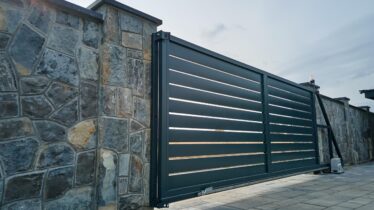
Cantilever gates provide secure access control without compromising ease of movement. The cantilever gate is one of the most efficient solutions available on the market. It is a type of sliding gate that moves sideways without relying on a ground track across the entrance. Instead, the system operates as a cantilever structure, supported by a roller system and guided by a frame that keeps the gate suspended slightly above the ground.
Unlike traditional sliding gates that rely on ground tracks, cantilever gates operate without any track system, making them ideal for environments where debris, uneven ground, or weather conditions such as snow and ice can affect performance.
This design significantly reduces interference from dirt, gravel, snow and surface irregularities, which explains why cantilever gates are widely used for residential, commercial and industrial access across the UK. By eliminating the need for a ground track, the system also reduces wear and tear and lowers long-term maintenance requirements, as fewer exposed components are affected by external conditions.
The result is smooth operation, strong security performance, and a more predictable maintenance cycle. This is especially important for automated gate systems used in workplaces and communal residential developments, where safety, liability, and access control must be carefully managed through reliable modern access control systems.
What is a Cantilever Gate?
A cantilever gate is, essentially, a type of sliding gate that operates without a ground track along the passageway. Whilst a standard sliding gate runs on wheels supported by a track fixed to the ground—making it more suitable for flat and controlled surfaces that support consistent operation —the cantilever gate uses a cantilevered structure supported by a roller system mounted to a side post.
The gate leaf is carried by carriages and guide rollers, allowing it to move parallel to a wall or fence without direct contact with the ground or the need for a ground track. This trackless design improves reliability in environments where traditional sliding gates are affected by debris, uneven ground, or adverse weather conditions such as snow and ice.
This creates the characteristic ‘floating gate’ effect, as the structure appears to glide above the surface. The key difference lies in weight distribution. In a cantilever system, the gate leaf incorporates a counterbalance section, commonly known as the tail section, which extends beyond the actual opening to stabilise movement.
When specifying cantilever gates, the gate’s weight and overall dimensions must be carefully calculated to ensure compatibility with the roller system, supporting posts and hardware components. This is essential for maintaining smooth operation, structural integrity and long-term durability.
Because of this counterbalanced design, the total width of the gate is typically greater than the clear opening it secures. While this requires additional side space for retraction, it results in a space-efficient solution at the entrance itself, particularly in sites where swing gates are not practical.
Overall, cantilever gates are engineered for smooth operation, reduced wear and lower maintenance requirements, making them suitable for high-security residential, commercial and industrial access environments.
How Does this Gate System Work in Practice?
The operating principle of the gate system is simple to understand, even though the engineering behind it is highly precise. When the user initiates the opening—via remote control, keypad, intercom, access card reader or other access control methods—the system’s motor engages and drives the gate leaf along the side run. Automated cantilever gate systems typically use a motor connected to a gear rack or chain mechanism, delivering controlled movement with reduced friction and minimal wear compared to traditional sliding gates.
The cantilever design is particularly effective for sites with uneven or sloped ground, as the gate remains fully suspended and does not require a level ground track to function correctly, making it ideal for varied terrain conditions.
In manual versions, the mechanical principle remains the same, with only the method of operation changing. Smooth performance is achieved through the combination of the structural base rail integrated into the gate leaf, the roller system mounted on the support post, and the guide rollers that maintain upper alignment. These top guide rollers also prevent lateral movement, ensuring stable and controlled operation throughout the sliding cycle.
The system does not operate on the ground and is fully supported by its cantilever structure. This significantly reduces exposure to water, mud, loose stones and other debris that commonly affect tracked sliding gates and increase maintenance requirements over time.
For this reason, cantilever sliding gates are widely specified for environments with uneven terrain, heavy traffic and exposure to extreme weather conditions. Another key consideration is correct load calculation. The gate’s weight must be compatible with the cantilever kit, motor, support posts and overall structural design to ensure safe and reliable operation.
In high-traffic environments such as apartment blocks, logistics yards and commercial premises, correct specification directly impacts durability, safety and smooth operation. Poorly balanced systems can increase wear and tear and reduce long-term performance.
In practice, the operating cycle is straightforward: a command is issued, the motor or manual force moves the leaf, the counterbalance section stabilises the structure, the guide rollers maintain alignment, and the structure slides open until the entrance is fully clear.
Once closed, the gate returns to the locking position, forming a continuous and secure barrier. In automated systems, a manual override is also commonly included, allowing operation during power cuts and ensuring uninterrupted access for vehicles in all conditions.
Which Components Make the Difference?
Although the gate system concept seems simple, a good installation depends on several elements working together. The gate leaf needs a frame that is sufficiently rigid to prevent twisting. The counterbalance section must be correctly sized. The roller system must be chosen according to the actual weight of the leaf.
And the upper guide rollers must keep the movement under control without causing excessive friction. When any of these components is undersized, wear, noise, and misalignment risks increase over time. In current projects, automation is also usually part of the discussion from the outset.
Motors, racks, sensors, photocells, safety edges and modern access control systems can be integrated according to the site’s context and overall gate system requirements. In a residential setting, this can mean greater convenience in everyday life. In a commercial or industrial site, it means controlling access, reducing unauthorised entry and maintaining a more predictable operational flow.
Aesthetics have also become a definite part of this equation. Powder-coated finishes, vertical bars, solid panels, combinations of steel and wood, and integration with existing fencing are now a natural part of the design, not an extra.
Materials and Construction of Cantilever Gates
Cantilever gates are engineered with a strong focus on durability, security, and aesthetic appeal, making them a versatile solution for both residential and commercial applications. The choice of materials plays a crucial role in overall performance, longevity, and suitability for different environments.
Galvanized steel is widely used in high-security environments and industrial sites due to its exceptional strength and resistance to corrosion, even in extreme weather conditions. For projects requiring a lighter and more low-maintenance solution, aluminium alloys provide excellent rust resistance and smooth operation, making them well suited to varied terrain and climates. Wood-metal hybrid designs combine the natural warmth of timber with the structural integrity of steel, offering a premium aesthetic often used in high-end residential developments and boutique commercial properties.
The construction of cantilever gates is defined by a robust counterbalance system. Unlike traditional sliding gates that rely on a ground track, cantilever gates incorporate a tail section—typically extending around 30% to 40% beyond the actual opening—which balances the gate’s weight and ensures stable, smooth operation.
This trackless design allows the gate to move along the fence line, supported by a roller system mounted on a stable post or pillar. Top guide rollers maintain precise alignment throughout movement, reducing strain, wear and tear, and ensuring consistent performance even in areas with uneven ground or heavy traffic.
One of the key advantages of this gate system is its space-efficient design. Cantilever gates require no ground track across the entrance and open by sliding to one side, making them ideal for properties with limited space or driveways where swing gates are not practical due to their opening arc.
The absence of a ground track also reduces exposure to debris, dirt, and snow, significantly lowering maintenance requirements and improving reliability throughout the year. This makes cantilever sliding gates particularly suitable for environments where tracked sliding gates would be more vulnerable to obstruction or wear.
To enhance both durability and appearance, cantilever gates are commonly finished with a powder-coated surface. This provides long-term protection against UV exposure and corrosion, while offering a wide range of colour options to suit different architectural styles. Solid panels and custom infill designs allow full flexibility, from modern minimalist installations to more traditional boundary fencing systems.
Safety is a fundamental part of modern cantilever gate design. Advanced roller systems, obstacle detection technology, and secure locking mechanisms ensure safe operation in both residential and high-security commercial environments. When integrated with modern access control systems, the gate becomes part of a fully managed entry solution, improving both safety and operational control.
Overall, the materials and construction of cantilever gates deliver a balance of strong security, smooth operation, and reduced maintenance requirements. Their trackless, space-efficient design sets them apart from traditional sliding gates, making them a reliable and visually refined solution for modern access control across residential, commercial, and industrial settings.
Cantilever Gates, Tracked Sliding Gates and Swing Gates: What is the Difference?
A cantilever gate is often the preferred choice when the priority is to avoid a ground track exposed to the elements and dirt. On uneven surfaces, gravel driveways, areas prone to debris build-up and high-traffic environments, this becomes a significant advantage. Key benefits of cantilever gates include long operational lifespan, reduced exposure to wear and tear, and reliable performance even in extreme weather conditions and challenging ground conditions.
Cantilever gates operate without ground tracks, which helps prevent obstructions caused by debris, snow, or mud. This makes them particularly suitable for applications where reliability and consistent operation are essential, especially in commercial and residential access control environments.
Tracked sliding gates remain a practical solution in many installations, particularly where the layout naturally supports a ground track system or where design requirements and opening width make them more suitable. While mechanically efficient, tracked sliding gates are generally more maintenance intensive, requiring a suitable floor surface and regular cleaning to prevent obstruction and ensure smooth operation.
This results in lower maintenance requirements in environments exposed to dirt, ice, or debris. This does not eliminate maintenance entirely, but it significantly reduces dependence on ground conditions and track upkeep.
When compared to swing gates, cantilever systems also offer advantages in many scenarios. Swing gates require clear space for their arc-shaped opening, which can be restrictive on short driveways, entrances close to public roads, or sites with limited space. In contrast, a cantilever gate slides laterally, keeping the entrance area fully clear without encroaching on vehicle movement space.
However, this design does require additional side clearance to accommodate the gate leaf and counterbalance section. As a result, cantilever systems are more space-efficient at the entrance itself, but require more lateral run-back along the boundary line.
Where do Cantilever Sliding Gates Make the Most Sense?
In the UK, cantilever systems are particularly suitable for high-end residential entrances, schools, logistics centres, business parks, public facilities and commercial entrances subject to frequent use. This is partly because the system combines robust security, adaptability to different surfaces and reliable long-term performance.
In a residential driveway, for example, the system can make a lot of sense when the property is not well suited to swing gates, when there is a slope, or when the owner wants a clean, modern solution with automation.
In commercial and industrial settings, the appeal is often even greater. The gate offers a more robust visual presence, withstands more intense entry and exit routines, and integrates easily with intercoms, readers, cameras and other access control features.
For properties that value both security and aesthetic appeal, this combination is particularly strong. However, the cantilever is not automatically the best choice for every site. If the site lacks adequate side clearance, the design may become unfeasible or lose efficiency.
Generally speaking, the gate requires a run-back area approximately 30% to 40% greater than the width of the opening, or roughly 130% to 140% of the span, precisely to accommodate the tail section. This is one of the most important pieces of information during the specification phase and one of the key factors in avoiding purchasing errors.
Safety, Automation and What to Consider in the UK
In the UK, an automated gate should not be treated merely as an aesthetic feature or a convenience. The HSE makes it clear that powered gates installed in workplaces or communal residential areas are subject to health and safety legislation, with owners, landlords, occupants, and managing agents all holding ongoing responsibility for user safety.
The same guidance highlights that such equipment requires maintenance throughout its service life and that, due to varying environments and installation conditions, most powered gates require a specific risk assessment. This directly influences how cantilever gates should be specified and integrated into modern access control systems.
Safety features such as sensitive edges, contactless sensors, fixed guards, and obstruction detection systems are not optional extras; they are a core part of the overall safety strategy. DHF also states that force testing is still required during installation, even when the equipment carries a conformity mark, as real-world performance depends on actual site conditions.
In day-to-day operation, this means that the most effective gate system is not simply one that opens and closes reliably, but one that is correctly specified, installed, and maintained in line with its environment. A residential access point will typically require a different configuration from a high-traffic logistics yard or commercial entrance.
Sites exposed to ice, rain, debris, or heavy use may require different hardware selections compared to more sheltered urban locations. This is where the role of a specialist supplier becomes essential—not only providing the gate itself, but designing a complete system tailored to usage patterns, security needs, and site-specific operational requirements.
Why Choose Ursa Gates
Ursa Gates is a Glasgow-based installer of automated vehicle and pedestrian access systems, with over 25 years’ experience and a presence throughout the UK and the Republic of Ireland. The company offers comprehensive project management, from design to completion, as well as maintenance contracts and installations that comply with current legislation and HSE standards.
These are important considerations when discussing cantilever gates, as this type of solution relies heavily on correct sizing, component integration and careful installation. Furthermore, Ursa Gates works with bespoke solutions, offering both models based on client designs and proposals developed in-house.
With a cantilever gate, this matters because the gate’s appearance, the type of infill, the materials and the integration with the fence or the rest of the façade are just as important as the mechanism. When security, operation and appearance need to work together, the value lies less in the product on its own and more in the complete solution.
Summary
A cantilever gate operates on a counterbalance system, allowing it to move smoothly without the need for a ground track across the entrance, unlike a standard sliding gate that relies on a fixed ground track system for movement. Unlike swing gates, it does not require outward or inward opening space, making it a robust solution for sites with uneven terrain, gravel driveways, dirt, snow, or heavy traffic environments where reliability is essential.
In comparison, sliding gates operate along a ground track, which can be effective in suitable conditions but is generally more dependent on a level, well-maintained surface and regular maintenance of the track system to ensure smooth operation and reliable performance over time. This makes cantilever gates particularly advantageous where ground conditions are less predictable or where reliability and reduced maintenance are priorities.
At the same time, cantilever systems require adequate side clearance, correctly specified components, and professional installation, especially when integrated with automation and modern access control systems in high security environments. In the UK, this is particularly important, as powered gate installations are subject to strict safety, maintenance, and risk assessment requirements throughout their operational life under HSE guidance.